THE RECRUITMENT BUSINESS GROWTH PLAYBOOK
A strategic briefing for recruitment founders scaling beyond £2M revenue.
Used by recruitment founders building businesses between £2M and £20M who want growth without founder dependency.
Most recruitment businesses sit in
one of three growth positions
Which one best describes your recruitment business today?
1. Founder-Driven Growth
Your recruitment business is performing well. But:
- most new clients come through you
- key client relationships sit with you
- stepping away from the business would slow revenue
Growth still depends on the founder.
2. Transitional Growth
You have good consultants in place.
Some generate clients. But:
- pipeline still fluctuates
- key deals still involve the founder
- growth remains inconsistent
The business is capable of scaling, but the structure is incomplete.
3. Structural Growth
Client acquisition is predictable.
Consultants generate new business independently.
Leadership operates without constant founder involvement.
The business can grow without depending on the founder.
Most recruitment businesses sit somewhere between Position 1 and Position 2.
Which is exactly where structural change becomes necessary.
Understand where your recruitment business currently sits.
or
The £2M–£10M Recruitment Ceiling
Most recruitment businesses grow successfully to a point.
Then something subtle begins to happen.
Growth slows.
Client acquisition becomes inconsistent.
And the founder finds themselves pulled back into sales again.
Not because the team isn’t capable.
But because the business structure was never designed to scale without the founder.
This is where most recruitment businesses stall.
Short explanation of the Recruitment Growth Architecture.
The Structural Constraints Most Recruitment Businesses Face
Across the recruitment industry, businesses typically encounter the same three problems.
Client Acquisition Becomes Relationship Driven
New clients often come from:
- referrals
- founder relationships
- occasional business development pushes
When activity slows, pipeline slows.
Growth becomes unpredictable.
The Founder Remains the Growth Engine
Even with consultants in place:
- major clients expect founder involvement
- the founder wins the most important assignments
- business development never becomes systematic
The business grows. But it cannot scale.
Hiring Becomes the Default Growth Strategy
Many recruitment businesses attempt to solve growth by hiring more consultants.
More recruiters.
More salespeople.
But this increases cost without fixing the underlying growth system.
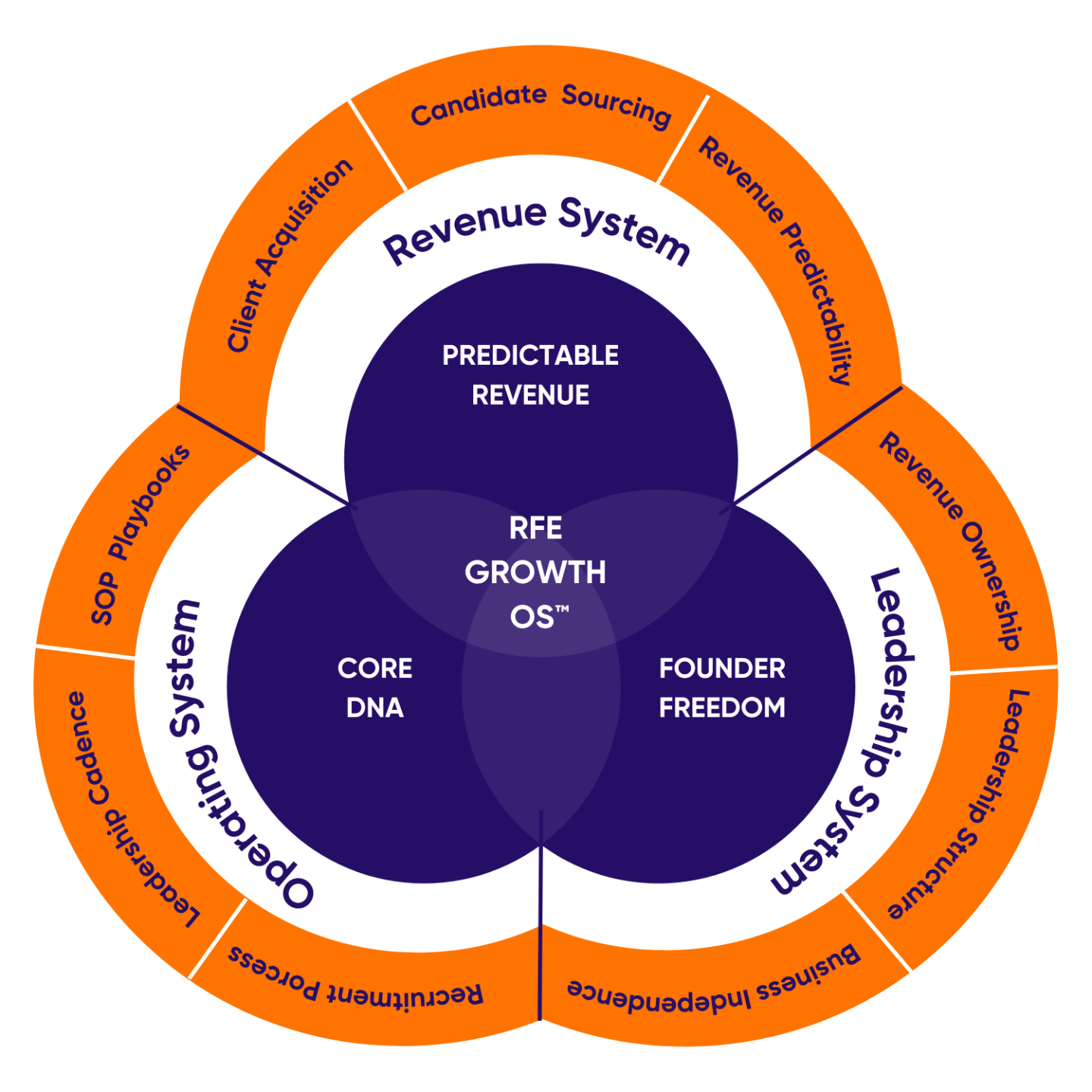
The Recruitment Growth Architecture
Scalable recruitment businesses rely on structure, not effort.
At Ready For Exit we install a simple growth architecture inside the business.
Client Acquisition Engine
↓
Recruitment Operating System
↓
Exit Readiness Architecture
Client Acquisition Engine
A consistent, repeatable flow of qualified client conversations.
Includes:
- structured outbound client acquisition
- market positioning and authority
- retained search frameworks
Recruitment Operating System
The internal structure that allows the business to scale.
Includes:
- delivery systems
- consultant performance frameworks
- leadership structure and accountability
Exit Readiness Architecture
What ultimately creates enterprise value.
Includes:
- diversified revenue
- predictable client acquisition
- transferable leadership
Short explanation of the Recruitment Growth Architecture.
Recruitment Case Snapshots
£8M Life Sciences Recruitment Business
Situation
The founder was responsible for most new client relationships.
Consultants were strong on delivery but relied on the founder to open doors with new clients.
Intervention
Installed a structured client acquisition system alongside a retained search model.
Result
- 14 retained assignments secured within 7 months
- founder removed from day-to-day client acquisition
- revenue growth increased by 41%
£4M Technology Recruitment Business
Situation
Growth had plateaued and the business relied heavily on referrals.
Consultants focused almost entirely on delivery rather than proactive client acquisition.
Intervention
Installed a systemised client acquisition engine and structured business development process.
Result
- consistent flow of new client conversations every month
- three retained clients secured within six months
- reduced dependency on founder relationships
£12M Financial Services Recruitment Business
Situation
Strong revenue but operational dependency on the founder.
The founder remained involved in most important deals and decisions.
Intervention
Installed a recruitment operating system across leadership and performance management.
Result
- leadership team managing revenue performance
- founder stepped back from day-to-day sales activity
- continued revenue growth without founder involvement in every deal
What This Typically Unlocks for Recruitment Founders
When recruitment businesses install structural growth architecture several things begin to change.
Predictable Client Flow
New client conversations appear consistently each month rather than depending on referrals.
Consultant-Led Business Development
Consultants begin generating opportunities independently.
Leadership Leverage
The founder transitions from revenue generator to strategic leader.
Revenue Resilience
Client concentration reduces and forecasting improves.
Enterprise Value
The recruitment business becomes significantly more attractive to potential buyers.
For many founders this is the first time the business begins to feel like an asset rather than a job.
A Quick Founder Test
Many recruitment founders share this page with peers after recognising these questions.
Ask yourself:
- If you stepped away for 30 days, would client acquisition slow?
- Do most major clients still expect founder involvement?
- Do consultants consistently generate their own clients?
- Could the business continue growing without you driving sales?
If two or more of these questions feel uncomfortable, structural change is usually required.
Many founders pass this page to other recruitment business owners they know facing the same challenge.
Lorem Ipsum
Roy Ripper
Founder
- 38 years in the recruitment industry
- built and scaled multiple recruitment businesses
- installed retained search divisions inside major organisations
- coached hundreds of recruitment founders globally
Tony Cox
Founder
- youngest partner at Korn Ferry
- built, scaled and sold recruitment businesses
- led high-performance executive search teams
- board-level commercial leadership
Dee Parker
Growth Systems Architecture
Growth systems and outbound client acquisition architecture.
- designs scalable client acquisition systems for recruitment businesses
- builds outbound and growth infrastructure that supports predictable client generation
- background in operational marketing systems including Toyota GB
- specialist in growth infrastructure for professional services businesses
Who This Is For
This tends to resonate most with recruitment businesses that:
- generate between £2M and £20M revenue
- rely heavily on founder relationships
- want predictable client acquisition
- want to build long-term enterprise value
Next Steps
Most founders begin by understanding how their recruitment business is currently structured.
Option 1
Take the Exit Readiness Snapshot.
A short diagnostic that scores your recruitment business across the five structural drivers of scalable growth.
Option 2
Book a 20-Minute Strategic Review with Tony Cox.
Tony will walk through:
- where founder dependency exists
- where your growth model is strongest
- what structural changes would unlock the next stage of growth
You will leave with a clear action plan for the next 12 months.